Stateless vs Stateful: Memory vs Amnesia
To build giant systems (like Netflix or Uber), your servers must suffer from amnesia. It seems counter-intuitive, but forgetting who the user is at every request is the secret to infinite scalability. Welcome to the world of Stateless.
The Duel: The Local Bartender vs McDonald's
You walk in, he smiles: "The usual?". He knows your history, your name, and how many drinks you've had.
Problem: If this bartender is sick, the replacement knows nothing about you. You have to explain everything again.
- Simple to code initially (variables in memory).
- Hard to scale: the user is "married" to a specific server (Sticky Session).
At the counter, they don't know you. You must provide your order number every time.
Advantage: Any employee can serve you. If one register closes, you can go to another without issues.
- Infinite scalability: any server can process the request.
- Resilient: if a server crashes, no data is lost (since it stored nothing).
Visualization
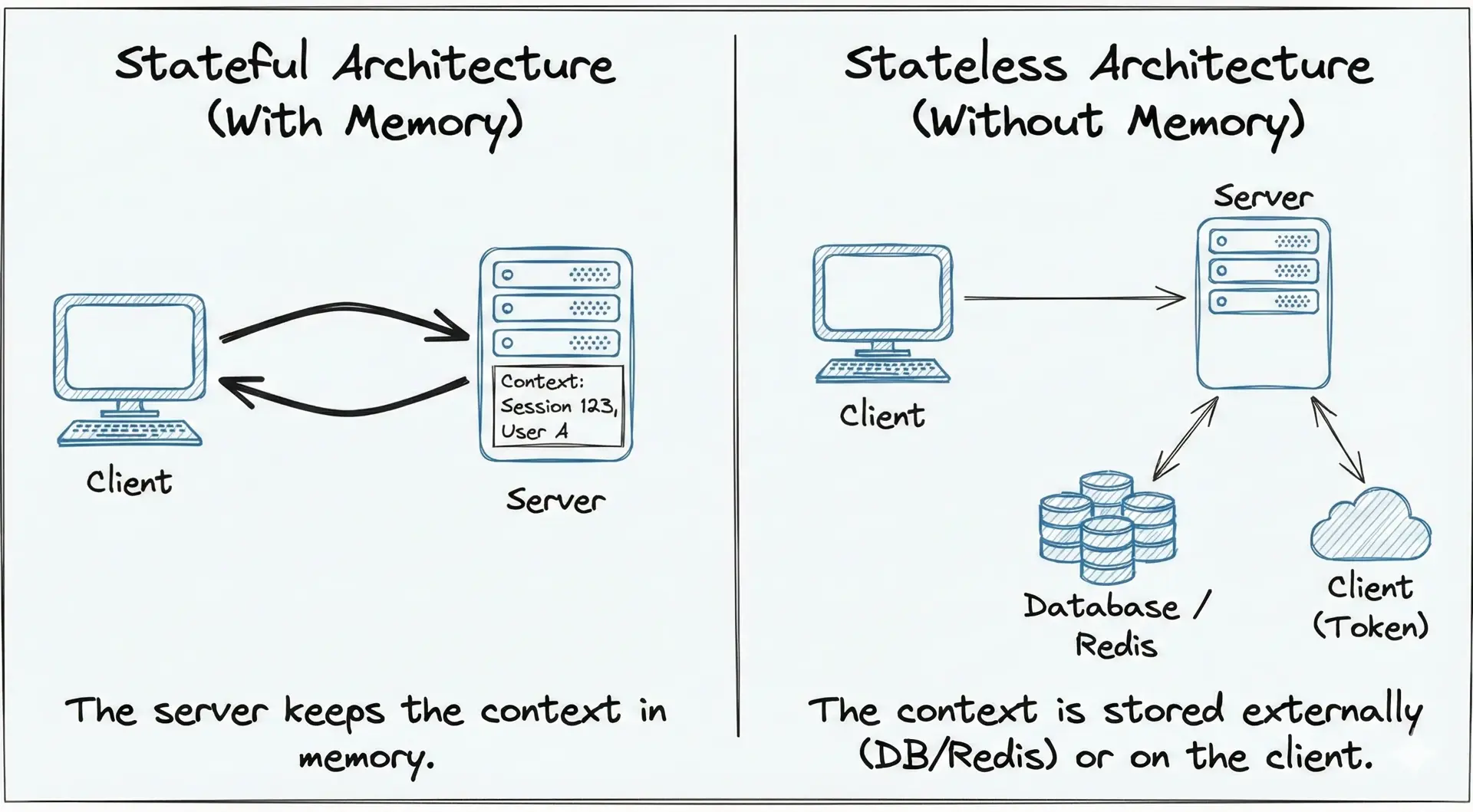
Comparison Table
| Criteria | Stateful | Stateless |
|---|---|---|
| Where is the data? | In the server's memory (RAM) | Database, Cache (Redis), or Client |
| If server crashes? | User gets logged out (session loss) | No impact, another server takes over |
| Scalability | Complex (Needs "Sticky Sessions") | Easy (Horizontal Scaling) |
The Secret: "Stateless" doesn't mean dataless!
Externalizing State
This is the most common confusion. A Stateless application NEEDS state (cart, logged-in user).
The difference is that the application server does not keep this state on itself. It pushes it to a dedicated service:
1. Redis (for temporary sessions).
2. PostgreSQL/MySQL (for durable data).
Thus, the application server becomes a simple interchangeable "processor".
Classic Traps
If you choose a Stateful architecture, you must configure your Load Balancer to always send Client IP 123 to Server A. This is fragile and creates load imbalances.
Beginner mistake: uploading a user's avatar to the server's hard drive. If the next request arrives at another server, the image will be "not found".
Solution: External Object Storage (AWS S3).
In Interviews (The System Design Interview)
By default, always design a Stateless architecture for the Web/API layer.
Flash Quiz
Your Turn
Mission: Make this system Stateless
Currently, the user connects to Server A. Server A keeps "User=Connected" in its RAM.
If the next request arrives at Server B, the user is rejected.
Your mission: Draw an external component (e.g., Redis) and show how Servers A and B can use it to share information.
For the Curious (Bonus)
Stateful (Pets): We give them names (Zeus, Apollo). If they get sick, we nurse them back to health.
Stateless (Cattle): They have numbers (s001, s002). If they get sick, we replace them with new ones. It's cruel, but that's the Cloud!