Lesson 01 · Fundamentals
What is a Distributed System?
Welcome to the real world. Here, a single machine is no longer enough. Let's discover why we complicate things by distributing our systems, and the classic traps (latency, failures) that await us.
1
The Concept
Official Definition
"A distributed system is a collection of independent computers that appears to its users as a single coherent system."
— Tanenbaum & Van Steen
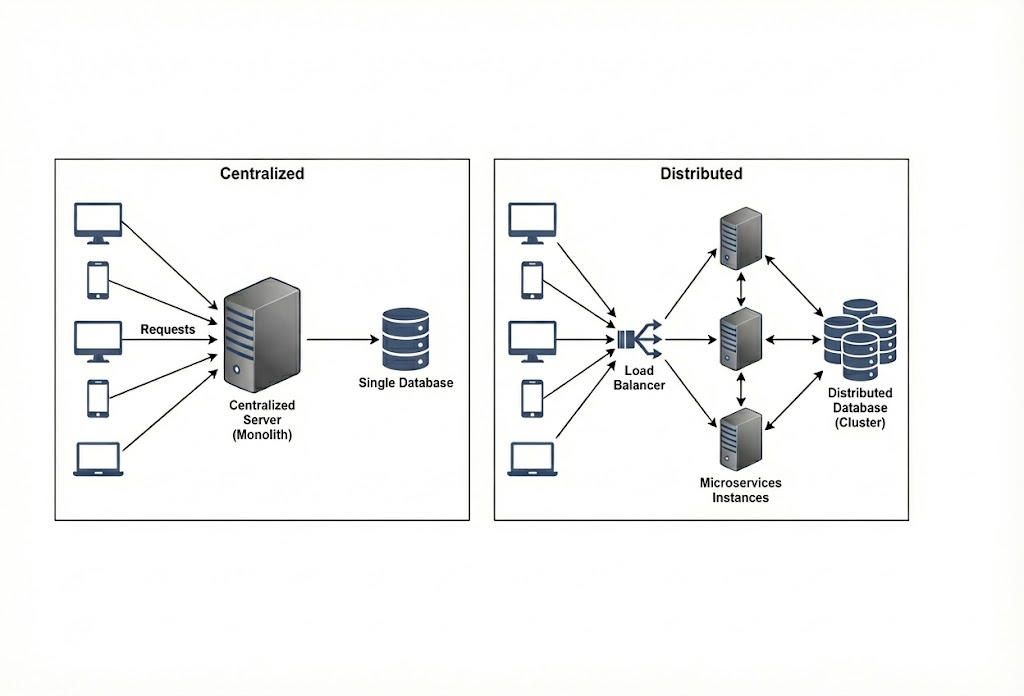
Centralized (Monolith)
One giant kitchen. All delivery drivers start from here.
- ❌ If the kitchen burns down, 0 meals delivered.
- ❌ Far from customers on the outskirts.
Distributed
Many small kitchens spread throughout the city.
- ✅ If one kitchen closes, the others take over.
- ✅ Closer to customers (fast).
2
Visualization [Image of centralized vs distributed network diagram]
3
Self-assessmentFlash Quiz
4
Your Turn
Mission: Scale the API
Your monolithic API is maxing out. Use the whiteboard below to draw the addition of a Load Balancer and 2 instances.
Tip: Don't forget the database! Does it remain unique for now? (It's a single point of failure, but okay for starting).
For the Curious (Bonus)
- Understand the 'Fallacies of Distributed Computing'
- Read about the CAP Theorem (we will come back to this)
- Watch how Netflix uses 'Chaos Monkey'
- The difference between Strong and Eventual Consistency